Table of Contents
1. Introduction: The Screenless Search Frontier
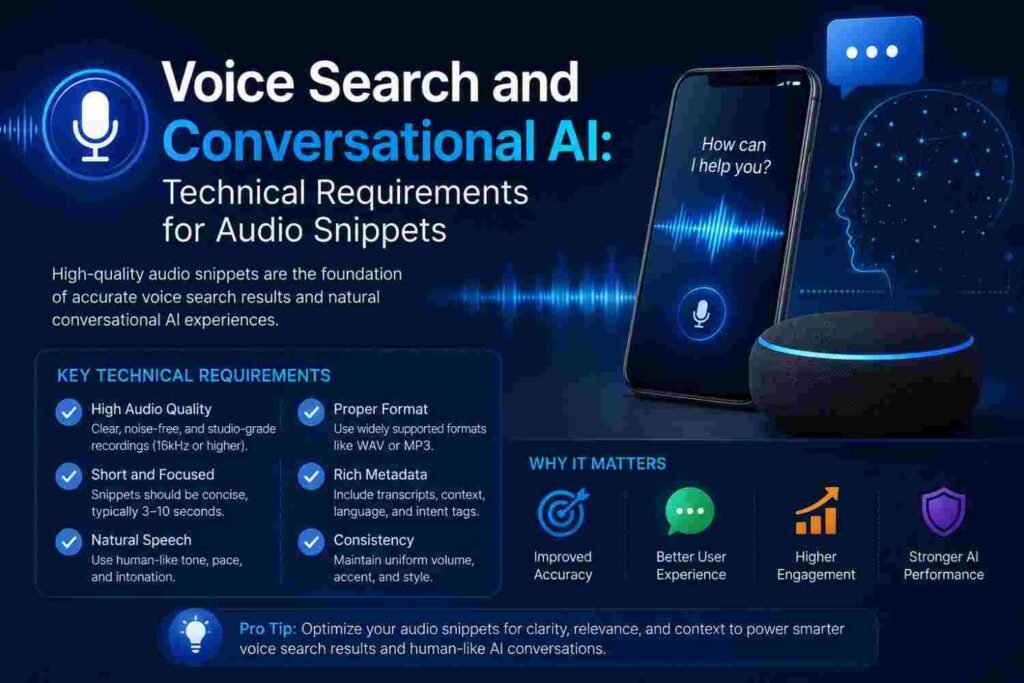
The search landscape is undergoing a fundamental shift from a visual-first medium to an audio-centric experience. As of the current market trajectory, there are over 150 million smart speakers in active use—including Google Nest, Amazon Echo, and Apple HomePod—alongside billions of voice-enabled smartphones. These devices process natural spoken queries every day, fundamentally altering how information is retrieved and consumed.
The critical distinction between traditional visual Search Engine Results Pages (SERPs) and voice search lies in the scarcity of the response. On a standard screen, a user can scan “10 blue links” or multiple featured snippets to find the most relevant information. In the screenless environment of voice search, the digital assistant reads only one single audio response. This “Winner-Takes-All” dynamic means the assistant selects a solitary source, often citing the brand directly (e.g., “According to Nova AI…”).
For voice search engineers and technical SEOs, the mission is clear: we must establish the technical standards, implement structured schema, and refine linguistic formatting to win the selection for Google Assistant audio snippets. Failing to optimize for this single-result environment means total invisibility in the conversational AI space.
2. How Voice Search Algorithms Select Audio Snippets
Understanding the selection process for audio snippets requires looking at the intersection of traditional search positioning and specialized linguistic processing.
The Position Zero Connection
Voice search does not exist in a vacuum. Data indicates that over 70% of voice search responses are sourced directly from existing Featured Snippets, also known as Position Zero. If a piece of content already occupies the featured snippet for a desktop or mobile search, it is the primary candidate for the voice response.
Linguistic Readability & Spoken Flow
Google’s Text-to-Speech (TTS) engines do not simply read text; they evaluate it for auditory efficiency. A core metric used is the Flesch-Kincaid grade level. For effortless auditory comprehension, technical SEOs should target a 7th–8th grade reading level. Content that is too complex for a listener to process in real-time is often bypassed in favor of simpler, more direct explanations.
Length & Conciseness Constraints
In voice search, brevity is paramount. The optimal voice answer length has been identified as approximately 29 words, which translates to roughly 4.2 seconds of spoken audio. This window allows the assistant to deliver a complete thought without overwhelming the listener. Responses that exceed 45 words are frequently truncated by the assistant or disqualified entirely during the selection process.
Entity Disambiguation & Knowledge Graph Match
Voice algorithms rely heavily on the Knowledge Graph to resolve intent. To be selected, your content must ensure voice queries map accurately to verified Knowledge Graph entity attributes. By aligning your content with established entities, you reduce the “noise” for the algorithm, making it easier for the assistant to verify your brand as an authoritative source.
3. The Role of SpeakableSpecification Schema Markup
To explicitly guide voice assistants toward the most relevant parts of a page, developers use the Speakable schema. This is an extension of Schema.org (schema.org/SpeakableSpecification) that identifies specific sections of a web document as being particularly suited for audio playback.
Supported Properties
The Speakable schema allows you to point the assistant to content using:
- cssSelector: Targeted selection of specific classes or IDs within the HTML.
- xpath: Precise expressions to navigate the document’s structure to reach the summary paragraph.
Implementation Example
For a technical implementation within a NewsArticle, the JSON-LD structure should appear as follows:{
“@context”: “https://schema.org”,
“@type”: “NewsArticle”,
“headline”: “Google Announces Broad Core Algorithm Update Guidelines”,
“image”: [“https://toolzreviews.com/hero.jpg%22],
“datePublished”: “2026-08-16T08:00:00+00:00”,
“author”: {
“@type”: “Person”,
“name”: “Alex Mercer”
},
“speakable”: {
“@type”: “SpeakableSpecification”,
“cssSelector”: [“.voice-summary-lead”, “.key-takeaway-block”]
}
}
By using this markup, you are essentially “pre-packaging” the audio snippet for the Google Assistant, increasing the likelihood that your designated text will be the one read aloud.
4. Structured Comparison: Text-First Article vs. Voice-Optimized Audio Snippet Asset
The following table highlights the technical and stylistic differences between content designed for reading and content designed for listening.
| Optimization Factor | Traditional Text-First Blog | Voice-Optimized Audio Snippet Asset | Sentence Length | Can vary from 10 to 30+ words; multi-clause. | Strictly concise; averages 15 words per sentence. |
|---|---|---|---|---|---|
| Word Count | 1,000+ words for depth and SEO. | 25–40 words for the primary answer block. | Pronunciation Clarity | Relies on visual context for abbreviations. | Expanded acronyms; no phonetic ambiguity. |
| Schema Integration | Article, Breadcrumb, Review schema. | Speakable, PodcastEpisode, AudioObject. | Google Assistant Delivery | Often ignored unless in Position Zero. | Priority delivery via designated CSS selectors. |
5. Linguistic Formatting Rules for Voice Audio Snippets
Technical SEO for voice is as much about linguistics as it is about code. To ensure a seamless Text-to-Speech experience, follow these four foundational rules.
Rule 1: Eliminate Complex Parentheses & Footnotes
TTS engines often struggle with punctuation that isn’t meant to be spoken. Brackets, technical citations in parentheses, and footnotes can cause the assistant to stumble or read out characters that confuse the listener. Ensure the text is a “clean” transcript of what should actually be said.
Rule 2: Expand Acronyms on First Mention
Phonetic pronunciation is a common failure point for voice snippets. While a human reader knows that “SEO” is pronounced as individual letters, an AI might struggle with less common acronyms. Always spell out acronyms on the first mention to provide the TTS engine with the full phonetic context.
Rule 3: Use Subject-Verb-Object Linear Structure
Complexity is the enemy of audio retention. Avoid convoluted, multi-clause sentences. Instead, utilize a linear Subject-Verb-Object (SVO) structure. This ensures that even if the listener is distracted, the core message of the sentence remains clear.
Rule 4: Conversational Opening Phrasing
Voice interactions are inherently transactional. Users want the answer immediately. Structure your snippets to open with a direct, spoken resolution. For example, instead of “There are many factors involved in recovery,” use “To recover from a Google core update, you must…”
6. Audio Search Optimization for Podcasts and Video Transcripts
Voice search isn’t limited to reading text from a blog; it also indexes existing audio and video assets.
- Structured Markup: Integrate PodcastEpisode and AudioObject schema to define the metadata of your files. This allows search engines to understand the duration, creator, and topic of the audio.
- Transcripts: Providing accurate, synchronized text transcripts for all podcast and video tracks is non-negotiable. These transcripts act as the “textual map” that the search engine uses to navigate the audio.
- ASR Indexing: Google utilizes Automated Speech Recognition (ASR) to index spoken keywords directly from the audio stream. However, relying on ASR alone is risky; providing your own clean transcript ensures that technical terms and brand names are indexed correctly.
7. Actionable 7-Point Voice Search & Audio Snippet Checklist
Before deploying content intended for voice capture, run through this technical pre-launch checklist to ensure maximum compatibility with conversational AI.
1. Concise Summary: Is the primary answer formatted in a 25–40 word summary block?
2. Phonetic Flow: Has the text been read aloud by a human to ensure natural rhythm?
3. Reading Level: Is the Flesch-Kincaid grade level between 6th and 8th grade?
4. Schema Validation: Is the Speakable JSON-LD validated and pointing to correct CSS selectors?
5. Acronym Expansion: Are all complex acronyms and abbreviations expanded for TTS clarity?
6. Transcript Support: Are podcast and video tracks supported by full, clean text transcripts?
7. Latency Check: Is mobile page speed optimized to return snippet data in under 500ms?
8. Conclusion: Becoming the Spoken Authority
Optimizing for voice search requires a shift in perspective. It is no longer enough to be the most comprehensive source on a page; you must be the most clear and concise source in an audio stream. By adhering to the principles of brevity, linguistic clarity, and specialized schema implementation, brands can secure their place in the singular “Position Zero” of the audio world.
As smart assistants and conversational AI become the primary interface for human information retrieval, the transition to audio-first optimization is no longer optional. Structure your content for audio clarity today, and your brand will speak directly to millions of users worldwide through the devices they use most.
Last updated: August 31, 2026
[Author Bio: Abdul Hadi, Expert in Digital Marketing]