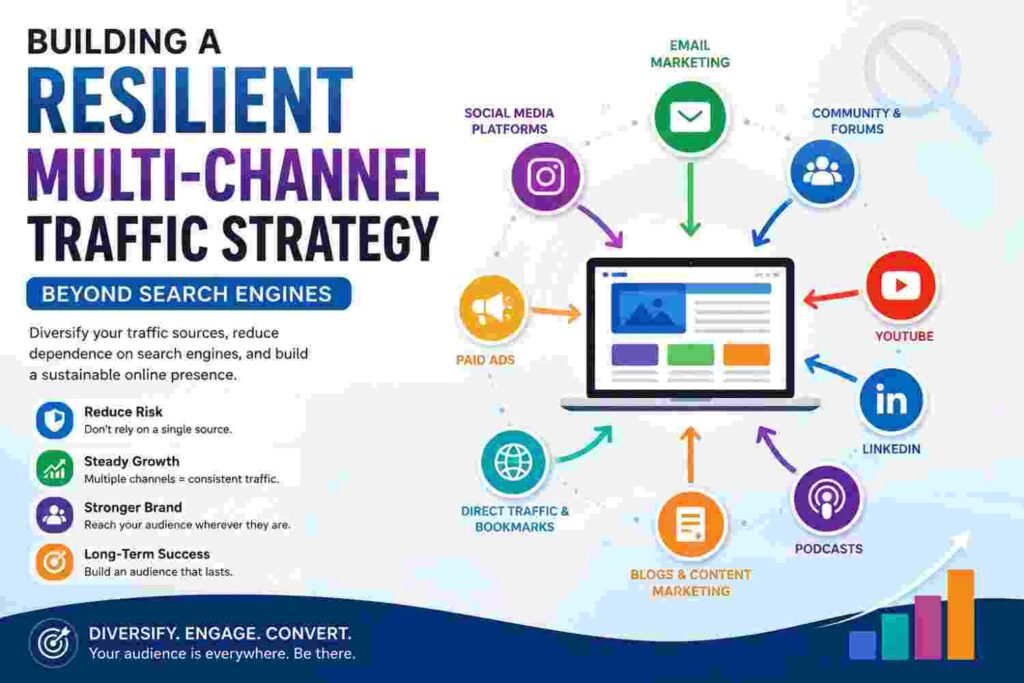
1. Introduction: The Danger of Single-Source Dependency and Designing a Strategy Beyond Search Engines
Table of Contents
For the modern digital entrepreneur, the allure of organic search traffic is intoxicating. It is, in many ways, the ultimate “free” customer acquisition vehicle. However, relying 100% on Google organic search traffic turns your digital business into a fragile enterprise. When your entire revenue model rests on the shifting sands of a single algorithm, you aren’t a business owner; you are a digital sharecropper. We are currently witnessing a platform risk reality where sudden algorithm shifts, radical SERP layout changes, and the rise of zero-click AI Overviews can evaporate years of growth in a single afternoon.
To thrive in the coming decade, publishers must adopt a sovereign media philosophy. True digital media sustainability is not found in chasing the next “hack” to stay on page one. It is found in building owned audience channels—ecosystems like email newsletters, direct navigation, podcasts, YouTube channels, and community hubs—where no single algorithm can wipe out your revenue overnight. In these spaces, you own the data, the relationship, and the distribution.
Interestingly, there is a paradoxical SEO benefit to this diversification. Modern search algorithms are increasingly sophisticated; they reward websites that exhibit strong brand signals, high levels of direct traffic, and social co-occurrence. When people search for your brand specifically or visit your site via a bookmark, it signals to search engines that you are a trusted authority. Diversifying your traffic actually makes your SEO stronger by proving you exist independently of the search bar.
The mission of this strategy is simple: to establish an actionable, multi-channel audience acquisition engine that insulates your business from search volatility and builds a lasting brand.
2. The 5 Pillars of an Owned & Resilient Audience Ecosystem
Building resilience requires a structural shift in how you view “traffic.” It is no longer about sessions; it is about relationships. Here are the five pillars that form the foundation of a sovereign media brand.
The High-Retention Email Newsletter Engine
Email remains the gold standard of digital marketing. With an estimated return of $36 to $42 for every $1 spent, it is the highest-ROI owned channel available. Unlike social media or search, where a middleman controls the reach, an email list is a portable asset.
To build a resilient newsletter engine, you must move beyond the simple “subscribe for updates” box. High-growth publishers use:
- High-Converting Lead Magnets: Solving a specific problem with a downloadable asset.
- Exit-Intent Opt-ins: Capturing the attention of visitors who are about to leave your site.
- Value-Packed Weekly Content: Newsletters that provide native value within the inbox, rather than just acting as a link-dump to your latest articles.
YouTube & Long-Form Video Search
While many view YouTube as a social platform, it is more accurately described as the world’s second-largest search engine. By creating long-form video content, you tap into a different intent-based audience. Video builds a level of trust and personality that text often lacks. The goal here is a conversion loop: use YouTube’s massive discovery engine to solve problems for viewers, then lead them into your owned ecosystem via descriptions and pinned comments.
Direct Navigation & Digital Brand Building
The most resilient form of traffic is the visitor who types your URL directly into their browser or clicks a bookmark. This is “Direct Navigation.” It represents the ultimate level of brand loyalty. Cultivating a dedicated readership requires consistent excellence and “utility-first” content—tools, templates, or resources that are so useful they are saved as a permanent part of the user’s workflow.
Community Platforms & Social Hubs
Resilient brands don’t just broadcast; they facilitate. Platforms like Reddit, LinkedIn, Twitter/X, and Discord allow you to build active discussion groups. The strategy here is “Native Insights.” Instead of posting links and hoping for clickouts, share your best findings directly on these platforms. When you provide value where the audience already lives, they will naturally seek out the source (your site) when they need deeper expertise.
Syndication, Podcasts & Audio Networks
Audio is the only medium that can reach your audience during “dead time”—commutes, workouts, and household chores. Visual search cannot compete in these moments. Launching a podcast or appearing on audio networks allows you to build an intimate relationship with your audience, effectively diversifying your brand’s presence into the ears of your target market.
3. The ‘Flywheel’ Content Distribution Engine
Creating unique content for five different channels is an exhausting, unsustainable task if done manually for each platform. The secret to resilience is a repurposing architecture that turns a single “Core Asset” into a distribution flywheel.
Imagine you have created a Core Asset: a 2,500-word comprehensive industry research guide based on original data. Here is how that single asset fuels six different channels:
- Spin 1 (Email): You write a 600-word “Executive Summary” for your newsletter. This isn’t the whole article; it highlights the single most surprising takeaway, providing immediate value while linking to the full research for those who want the data.
- Spin 2 (YouTube / Video): You record a 10-minute walkthrough. You share your screen, show the charts, and explain the methodology. This reaches the visual learners and taps into YouTube’s discovery algorithm.
- Spin 3 (LinkedIn / Twitter Thread): You take the top 5 charts from your research and turn them into a 10-slide visual carousel or a structured thread. This is designed for high virality and native consumption.
- Spin 4 (Podcast): You record a 20-minute audio discussion. You don’t read the article; you discuss the practical industry implications and the “so what?” behind the data.
- Spin 5 (Reddit / Community): You post the raw findings as a detailed, zero-link text post in relevant subreddits or Discord servers. You invite community debate. Once the post gains traction, you can mention the full guide in the comments.
This flywheel ensures that your high-value research reaches every corner of the internet without requiring you to write five different pieces of content from scratch.
4. Structured Comparison: Google-Dependent vs. Omnichannel Media
To understand the necessity of this shift, we must compare the structural health of a traditional niche site against a modern omnichannel media brand.
| Operational Dimension | Google-Dependent Niche Site (Fragile) | Omnichannel Media Brand (Resilient) | Traffic Source Concentration | 80% – 90% Google Organic | Balanced: Search, Direct, Email, Social |
|---|---|---|---|---|---|
| Revenue Stability | Highly Volatile; depends on SERP position | Stable; recurring via list and direct ads | Vulnerability to Updates | High; one update can end the business | Low; updates affect one of many channels |
| Reader Relationship | Transactional (one-off searchers) | Relational (loyal subscribers) | Business Valuation Multiple | 2x – 3x Annual Profit | 5x – 10x Annual Profit (Brand Equity) |
5. Transitioning from Search Capture to Audience Capture
If you currently have high-ranking search articles, you are sitting on a gold mine—but that mine could collapse at any time. You must transition from simply “capturing search” to “capturing the audience.”
Automated Email Capture Funnels
Every high-traffic article on your site should serve as an entry point into your owned ecosystem. Don’t wait for the visitor to find your “Contact” page. Use automated funnels that offer a “Content Upgrade” specific to that article. If the article is about “The Best Real Estate Marketing Strategies,” the upgrade should be a “Marketing Plan Spreadsheet.” This exchange of a high-value tool for a verified email address is the single most important action a visitor can take.
Creating Private Subscriber Perks
Give people a reason to stay. Beyond content, offer exclusive access. This might include:
- Private webinars or Q&A sessions.
- Access to a private Slack or Discord community.
- Early access to new tools, calculators, or repositories.
By offering these “Sovereign Perks,” you convert a random searcher into a member of your tribe.
6. Financial & Metric Diversification Benchmarks
What does a healthy, resilient business look like in terms of numbers? While every niche is different, these are the recommended traffic distribution targets for an enterprise-level web business looking to minimize risk:
- Google Organic Search: 40% – 50% max. While still a primary driver, it should never represent the majority of your traffic.
- Direct & Bookmark Traffic: 20% – 25%. This measures your brand strength and the “stickiness” of your site.
- Email Newsletter Traffic: 15% – 20%. This is your most reliable “on-demand” traffic.
- Social & Community Referral: 10% – 15%. This ensures you are staying relevant in the cultural conversation of your industry.
If your Google traffic is currently at 90%, your immediate goal is not to “fix SEO,” but to aggressively grow the other three buckets until the ratios align with these benchmarks.
7. Actionable 7-Point Traffic Diversification Checklist
Use this checklist with your marketing or content team to audit your current level of resilience:
1. Lead Magnets
Does every high-traffic article feature an engaging, relevant lead magnet opt-in?
2. Consistency
Is an active email newsletter sent consistently at least once per week?
3. Channel Presence
Does the brand maintain an active presence on at least two non-Google channels (e.g., YouTube, LinkedIn)?
4. Direct Growth
Is direct traffic growing as a percentage of total monthly site sessions?
5. Repurposing
Has a content repurposing workflow been automated for every new major guide?
6. Utility
Are website visitors incentivized to bookmark tools and resources through high-utility design?
7. Revenue Streams
Is revenue diversified across multiple streams (subscriptions, digital products, consulting, sponsorships)?
8. Conclusion: The Sovereign Media Empire
The era of the “low-effort niche site” is ending. In its place, the Sovereign Media Empire is rising. By diversifying your traffic across email, video, audio, and community hubs, you are doing more than just protecting your traffic—you are building a real brand with real equity.
The core principle remains: Don’t build your entire house on rented land. Search engines are a powerful discovery engine; use them to capture readers. But once you have them, convert those readers into lifelong direct relationships that belong to you forever. The goal is to reach a point where, even if Google were to disappear tomorrow, your business would not only survive but continue to thrive.
Last updated: August 31, 2026
[Author Bio: Abdul Hadi, Expert in Digital Marketing]