Table of Contents
1. Executive Summary & The Vision for the Next Half-Decade
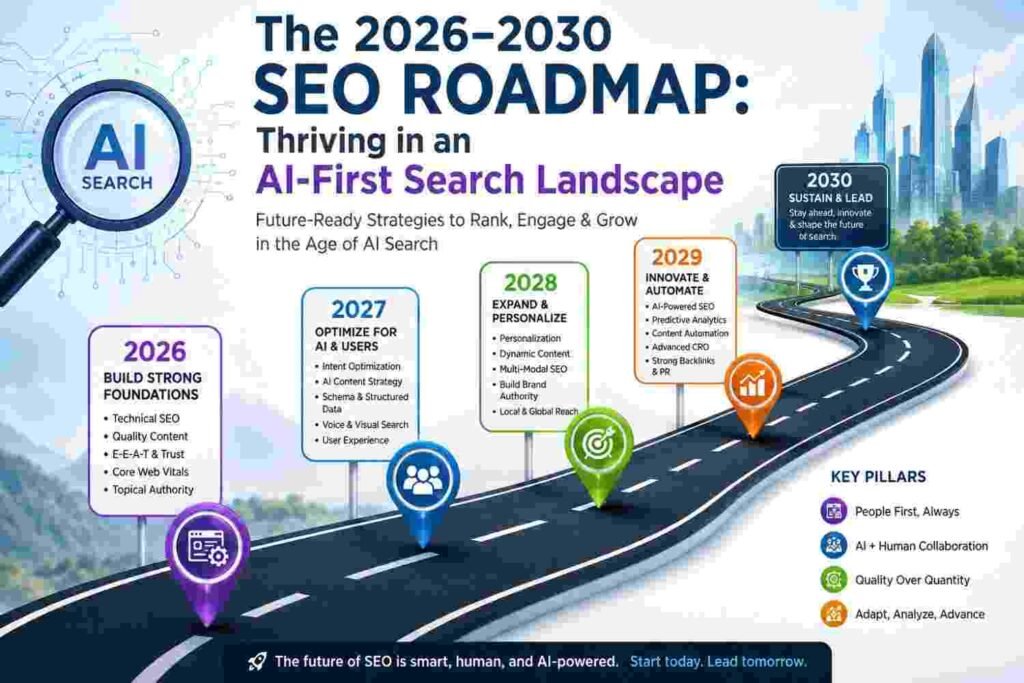
As we look toward the 2026–2030 seo roadmap horizon, the discipline of Search Engine Optimization is undergoing its most profound metamorphosis since the inception of the web. This roadmap synthesizes a comprehensive 100-article curriculum, detailing the transition from primitive keyword string matching to a sophisticated era of semantic entities, multimodal understanding, and generative AI synthesis.
The fundamental truth of modern search is that SEO is no longer a game of tricking an algorithm into ranking a page. Instead, it is the strategic process of building an irreplaceable digital institution—an entity so authoritative and relevant that search engines, AI models, and human users find it impossible to ignore.
The vision for the next half-decade is defined by the convergence of several high-order technological shifts:
- Generative Engine Optimization (GEO): Moving beyond clicks to citation share within AI-generated responses.
- Multimodal Search: Adapting to a world where voice, visual, and spatial queries are the primary modes of interaction.
- Real-Time Agentic Automation: Preparing for a web navigated by autonomous AI agents acting on behalf of consumers.
- Zero-Compromise Human E-E-A-T: Establishing radical transparency and expertise as the only sustainable defense against synthetic content saturation.
This document serves as the definitive operating roadmap for C-suite executives and digital visionaries to lead, scale, and dominate the AI-first search economy.
2. The 5 Mega-Trends Shaping Search from 2026 to 2030
1. The Shift from Search Engines to Answer Engines (GEO & SGE Domination)
Traditional Search Engine Results Pages (SERPs) are being systematically replaced by conversational generative synthesis. In this environment, the goal is no longer just a blue link; it is “citation share.” Brands must optimize for entity salience, ensuring their proprietary insights are the primary sources referenced by the generative engines.
2. Autonomous Agentic Web Interactions
The rise of AI agents—integrated into systems like Gemini, ChatGPT Agents, and Apple Intelligence—changes the fundamental nature of the user journey. These agents will autonomously browse the web, compare options, and complete transactions without a human ever visiting a traditional landing page. SEO now involves making your data “agent-readable” and trustworthy enough for an AI to select your brand for a purchase.
3. Multimodal Spatial & Voice Search
The interface of search is migrating away from the keyboard. Smartphone cameras, smart glasses, and ambient voice interfaces are projected to capture over 50% of daily search volume by 2030. Success requires content that is optimized for visual recognition and natural language processing in real-world contexts.
4. Radical Quality & Provenance Verification (The C2PA & E-E-A-T Era)
As synthetic text farms proliferate, search engines are implementing harsh automated penalties for ungrounded content. The introduction of cryptographic content credentials (C2PA) and verified human authorship is the new standard. To survive, brands must prove their content’s provenance and lean heavily into the Experience, Expertise, Authoritativeness, and Trustworthiness (E-E-A-T) framework.
5. The Death of Commodity Informational Content
Simple definitions, trivia, and “what is” style queries are now fully answered directly on the SERP. Traffic is consolidating exclusively into deep proprietary research, interactive software tools, and hubs of first-hand experience. If an AI can summarize your page in two sentences without losing value, that page is functionally obsolete.
3. The 4-Pillar Modern SEO Architecture (The Sustainable Flywheel)
To build a resilient digital presence, enterprises must focus on four critical pillars that form a sustainable SEO flywheel.
Pillar 1: Technical & Performance Flawlessness
Infrastructure is the baseline. We must achieve instantaneous edge-rendered HTML through SSR/ISR (Server-Side Rendering/Incremental Static Regeneration). The target for Core Web Vitals is now “good” at an elite level: Interaction to Next Paint (INP) under 100ms and Largest Contentful Paint (LCP) under 1.5s. This must be coupled with a comprehensive JSON-LD entity graph schema that maps every aspect of the brand’s knowledge.
Pillar 2: Information Gain & Human-in-the-Loop Synthesis
The 80/20 production model is the new content standard. This utilizes AI for operational speed (80%) while reserving the critical 20% for human-in-the-loop synthesis. Every piece of content must provide “Information Gain”—original proprietary datasets, unique case studies, and reviews from named subject matter experts that cannot be replicated by a LLM.
Pillar 3: Brand Entity & Knowledge Graph Dominance
Dominance is defined by your footprint in the global Knowledge Graph. This requires verified presence across sources like Wikidata and Crunchbase, and consistent co-occurrence with high-authority press. The objective is to drive branded query volume, making your brand a recognized entity rather than a collection of keywords.
Pillar 4: Omnichannel Audience Sovereignty
Revenue durability depends on independence from any single algorithm. By building multi-channel distribution hubs—such as email newsletters, YouTube video ecosystems, and interactive calculators—brands ensure that they own their audience even if search landscapes shift overnight.
4. Structured Multi-Year Milestone Matrix: The 2026–2030 SEO Evolution
| Year / Era | Primary Search Interface | Dominant Ranking Mechanism | Highest-ROI Content Asset | Greatest Vulnerability | Core Strategic Imperative |
|---|---|---|---|---|---|
| 2026: The Generative Transition | AI Overviews & Hybrid SERPs | SGE Synthesis & Core Web Vitals | Modular, Passage-Optimized Pillars | Index Bloat & Thin AI Content | Technical Excellence & GEO Alignment |
| 2027–2028: The Multimodal Era | Voice, Lens, & Agent Discovery | Entity Salience & Multimodal Understanding | Custom Diagrams & Structured Video | Loss of Direct Web Traffic | Multimodal Optimization & Agent Trust |
| 2029–2030: The Ambient Intelligence Era | Autonomous Synthesis & Wearables | Autonomous Agent Recommendation & Entity Trust | Proprietary Data Products & Tools | Synthetic Content Devaluation | Radical Transparency & Human Provenance |
5. The Enterprise SEO Operational Roadmap: 5 Actionable Phases
Phase 1: Immediate Audit & Pruning
The first step is a radical cleanup. Eliminate index bloat by removing or consolidating pages that do not provide unique value. Fix all Core Web Vitals bottlenecks and prune thin AI-generated pages that lack human oversight.
Phase 2: Entity & Schema Fortification
Establish a comprehensive Knowledge Graph for the brand. This involves creating and verifying profiles for the organization, its founders, and its core products. Ensure JSON-LD schema is used to define these relationships clearly for search engines.
Phase 3: Interactive Tool & Data Product Development
Move beyond static text. Build custom calculators, diagnostic tools, and annual benchmark studies. These assets provide high “Information Gain” and naturally generate passive backlink gravity as they become industry standards.
Phase 4: Multimodal Content Upgrades
Upgrade all primary content clusters. Embed custom diagrams, infographics, and structured video clips. This ensures your content can be surfaced by visual search (Lens) and voice-activated AI assistants.
Phase 5: Automated Machine Learning Diagnostics
Integrate Python-based anomaly detection into your workflow. By analyzing Search Console and server log datasets in real time, you can identify crawl issues or ranking opportunities before they impact the bottom line.
6. The Master SEO Maturity Model: Evaluating Your Readiness
| Assessment Category | Level 1: Ad-Hoc / Risky | Level 2: Structured / Compliant | Level 3: Visionary Market Leader | Content Strategy | High-volume commodity AI text. |
|---|---|---|---|---|---|
| Structured content with expert quotes. | Proprietary data products & 80/20 human-AI synthesis. | Technical SEO | Failing Core Web Vitals; no schema. | Passing Vitals; basic schema implemented. | Edge-rendered HTML; INP <100ms; deep entity schema. |
| Entity Authority | No Knowledge Graph presence. | Basic profiles on third-party sites. | Verified entity footprint; high branded query volume. | Multimodal Readiness | Text-only focus. |
| Images with alt-text included. | Video hubs & visual assets optimized for spatial search. | Data Governance | No performance monitoring. | Standard monthly reporting. | Real-time ML anomaly detection & server log analysis. |
7. Actionable 10-Point Master SEO Checklist for 2026–2030
1. Proprietary Value: Is every published article enriched with proprietary data, original testing, or expert quotes?
2. Performance: Are all Core Web Vitals metrics in the ‘Good’ threshold on mobile viewports?
3. Schema Accuracy: Is structured JSON-LD entity schema fully validated across all URLs?
4. Architecture: Are primary keywords mapped to deep, modular passage-optimized pillars?
5. Entity Footprint: Does the brand maintain active, verified profiles across major Knowledge Graph sources?
6. Backlink Gravity: Are interactive tools or calculators actively generating passive editorial backlinks?
7. Sovereignty: Is a multi-channel audience funnel (email/video) capturing direct traffic?
8. Crawler Precision: Are robots.txt directives and AI crawler permissions configured with precision?
9. Automation: Is machine learning anomaly detection integrated into weekly SEO reporting?
10. Accountability: Is radical transparency and human editorial accountability upheld across all AI workflows?
8. Conclusion: The Everlasting Power of Authentic Human Utility
The journey across the last 100 articles has led us to one inescapable conclusion: search has evolved from a technical puzzle into a trust-based ecosystem. In an era where machines can generate an infinite number of words, human authenticity, genuine expertise, and radical helpfulness are the only ultimate competitive moats.
To thrive between 2026 and 2030, you must master the machine—optimizing for generative synthesis, agentic navigation, and technical perfection—but you must never lose sight of the human reader. By building a digital institution rooted in utility and provenance, you will not only survive the AI transition; you will lead the search landscape for decades to come.
Last updated: August 31, 2026
[Author Bio: Abdul Hadi, Expert in Digital Marketing]